Mailboxes in SystemVerilog: Producer–Consumer IPC and Synchronization for Verification Testbenches
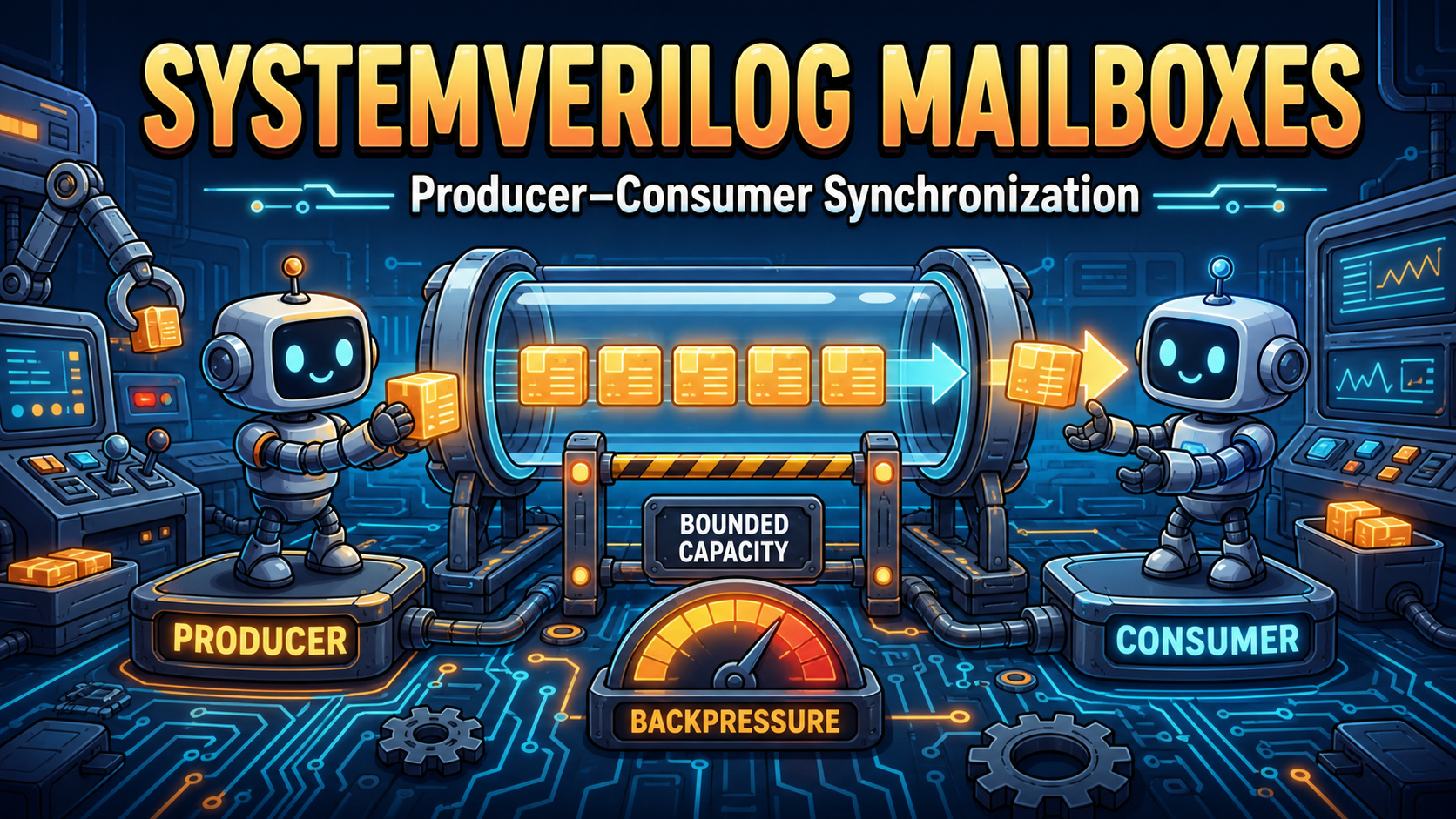
Verification components never run at the same rate. A generator can produce five transactions in zero simulation time. A driver has to wait for reset release, then clock edges, then DUT ready. A monitor samples pins every cycle while a scoreboard grinds through a slower reference model. If you connect those processes with direct task calls, the rate mismatch becomes your problem.
A SystemVerilog mailbox makes it the channel's problem. It transports payloads like a FIFO, but its blocking operations also synchronize the producer and the consumer. That combination is why I think of a mailbox as more than shared storage: it is a transaction channel with flow-control and ownership semantics built in.
One clarification up front. Mailboxes are testbench constructs, not synthesizable hardware FIFOs. Their value is in expressing concurrent verification behavior clearly and safely.
Why Concurrent Testbench Components Need IPC
Direct task calls tightly couple caller and callee. When a generator calls a driver task directly, generation gets entangled with protocol timing. The generator cannot naturally run ahead, and changing the driver's timing behavior ripples back into stimulus code. I have written testbenches that way early in my career, and it works fine in a two-hundred-line sandbox—right up until you want a second consumer, an error injector, or an extra monitor on the same path.
An inter-process communication channel separates three decisions that don't belong together: who creates a transaction, who consumes it, and when consumption happens.
The canonical transaction-level testbench has at least two such paths:
Generator ── requests ──> Driver ── pins ──> DUT
                                                │
Monitor <────────────── pins/responses ─────────┘
   │
   └── observed transactions ──> Scoreboard
The generator-to-driver path usually benefits from intentional backpressure. The monitor-to-scoreboard path often needs the opposite policy, because blocking a monitor can cause it to miss real DUT activity. So choosing to use a mailbox is only the first decision. Capacity, ownership, and shutdown behavior matter just as much.
What Is a SystemVerilog Mailbox?
A mailbox is a simulator-managed communication object through which concurrent processes exchange messages. It gives you FIFO storage plus operations that suspend a producer or consumer until progress is possible.
First gotcha, because I have lost debugging time to it: a mailbox variable is a handle. Declaring it does not construct the underlying mailbox.
mailbox #(packet) pkt_mbx;       // Null handle
mailbox #(packet) ready_mbx = new(); // Constructed mailbox
Calling a method through the unconstructed pkt_mbx handle is an error. In production code I construct the mailbox before starting any producer or consumer, and I pass that exact handle to every connected component. That way there is no global lookup and no chance of accidentally creating a second mailbox that nobody reads from.
Typed versus untyped mailboxes
SystemVerilog supports both flavors:
mailbox          raw_mbx = new();
mailbox #(packet) pkt_mbx = new();
An untyped mailbox can carry values of different types, which pushes you into runtime checks and casting at the receiving end. A typed mailbox documents the channel contract in the declaration itself, and it lets tools detect many type mismatches much earlier. For any stable transaction-level interface, mailbox #(transaction_type) should be the default.
Bounded versus unbounded mailboxes
Capacity is selected at construction:
mailbox #(packet) unbounded_mbx = new();
mailbox #(packet) bounded_mbx   = new(4);
An unbounded mailbox has no configured finite capacity, although simulator memory is still finite—something that matters more than people expect during a long regression. A bounded mailbox holds at most the specified number of entries, and when it is full, a blocking put() waits for space.
Here's how I think about capacity: it is an architectural policy, not a performance knob. A capacity of four is a statement that the producer may lead its consumer by four accepted messages before backpressure begins.
Mailbox Methods and Synchronization Semantics
The complete method set is small enough to keep in your head. It splits into blocking operations and immediate-attempt operations:
| Method | Blocking? | Removes item? | Key behavior |
|---|---|---|---|
put(item) |
If a bounded mailbox is full | N/A | Inserts an item |
get(item) |
If the mailbox is empty | Yes | Receives the oldest available item |
peek(item) |
If the mailbox is empty | No | Inspects the next item |
try_put(item) |
No | N/A | Immediately succeeds or fails |
try_get(item) |
No | Yes on success | Atomically attempts removal |
try_peek(item) |
No | No | Inspects an available item |
num() |
No | No | Returns an occupancy snapshot |
put() and producer backpressure
For an unbounded mailbox, put() normally completes without waiting for capacity. For a bounded mailbox, it blocks when all slots are occupied.
That blocking is usually a feature, not a bug. If a driver stalls because the DUT is stalled, a bounded generator-to-driver channel stops the generator from building an unlimited backlog. The stall propagates naturally through the testbench, which is exactly where you want it.
Use try_put() when the producer must not block. Its return value tells you whether the item was accepted, and then the caller has to decide what failure means: retry later, drop the item, record an error, or route it somewhere else. The mailbox gives you the outcome; the policy is still yours to write.
get() as a synchronization point
A blocking get() waits when the mailbox is empty and resumes when an item becomes available. No polling loop, no separate event, no hand-rolled handshake.
This is the ideal fit for a consumer whose only useful action is processing the next transaction. The mailbox carries the data and the wake-up condition in a single call.
peek() does not reserve an item
peek() returns the oldest available item without removing it. In a multi-consumer system, another consumer can successfully call get() after your process peeks. A peek() followed later by get() is therefore not an atomic inspect-and-consume operation.
If you genuinely need reservation, the protocol needs a separate ownership mechanism, or a single process responsible for removing and dispatching items. I have seen peek-based "reservations" produce double-handled transactions more than once.
Use try_* for immediate attempts
The nonblocking methods earn their keep when the process has other timing obligations: clock-by-clock polling, opportunistic work, reset observation, explicit timeout logic. In those cases the process cannot afford to sleep until the next item.
They are not automatically safer than blocking methods, though. Polling introduces additional control flow, and every unsuccessful attempt has to eventually advance simulation time or you have replaced one problem with a worse one.
num() is diagnostic, not synchronization
The num() method reports occupancy at the instant it executes:
if (mbx.num() > 0)
  mbx.get(pkt);
This check-then-act sequence is not atomic. Another consumer can remove the item after num() returns, and then your get() blocks anyway. When the requirement is "remove an item if one is available right now," the honest tool is try_get(). Reserve num() for diagnostics: backlog logging, high-water marks, watchdog checks.
Minimal SystemVerilog Mailbox Example
Enough theory. Here is a complete example with one producer, one consumer, and a typed integer mailbox:
module mailbox_basic;

  mailbox #(int) mbx = new();

  task automatic producer();
    for (int i = 0; i < 5; i++) begin
      $display("[%0t] producer sends %0d", $time, i);
      mbx.put(i);
      #2;
    end
  endtask

  task automatic consumer();
    int value;

    repeat (5) begin
      mbx.get(value);
      $display("[%0t] consumer receives %0d", $time, value);
      #5;
    end
  endtask

  initial begin
    fork
      producer();
      consumer();
    join
  end

endmodule
Notice what the consumer does not do. It never calls the producer, and it never polls for data. The get() supplies both the payload transfer and the wait. Because this mailbox is unbounded, the producer runs ahead of the slower consumer without ever being blocked by capacity.
Bounded Mailboxes and Backpressure
Now make the capacity two and watch backpressure become visible:
module bounded_mailbox_demo;

  mailbox #(int) mbx = new(2);

  task automatic producer();
    for (int i = 0; i < 5; i++) begin
      $display("[%0t] before put %0d", $time, i);
      mbx.put(i);
      $display("[%0t] after  put %0d", $time, i);
    end
  endtask

  task automatic consumer();
    int value;

    #10;
    repeat (5) begin
      mbx.get(value);
      $display("[%0t] consumed %0d", $time, value);
      #5;
    end
  endtask

  initial begin
    fork
      producer();
      consumer();
    join
  end

endmodule
The first two put() calls fill the mailbox. The "before" message for the third put() prints immediately, but its matching "after" message does not appear until the consumer removes an entry. That gap between the two prints is backpressure, made observable.
Increasing capacity buys more decoupling, but it can also hide a stalled consumer and postpone deadlock diagnosis. Choose a capacity that represents the producer lead you actually intend to permit. Do not ratchet it upward until the hang disappears and call that a fix.
A Typed Generator-to-Driver Channel
Realistic channels carry transaction objects, not integers. The transaction type should carry enough metadata to debug merged or reordered traffic:
typedef enum {READ, WRITE} operation_e;

class bus_request;
  rand bit [31:0] addr;
  rand bit [31:0] data;
  rand operation_e op;

  int unsigned source_id;
  int unsigned sequence_id;

  constraint aligned_c {
    addr[1:0] == 2'b00;
  }

  function bus_request clone();
    bus_request copy = new();
    copy.addr        = addr;
    copy.data        = data;
    copy.op          = op;
    copy.source_id   = source_id;
    copy.sequence_id = sequence_id;
    return copy;
  endfunction
endclass
The typed mailbox now has a clear contract: it transports bus_request handles. The source and sequence identifiers are not required by the mailbox, and the mailbox does not care about them. I have debugged interleaved streams from concurrent generators, though, and a sequence number was often the only clue about which producer originally owned a mangled transaction.
The generator allocates a fresh object per request, checks randomization, publishes, and then stops touching it:
class generator;
  mailbox #(bus_request) out_mbx;
  int unsigned source_id;

  function new(mailbox #(bus_request) out_mbx,
               int unsigned source_id = 0);
    this.out_mbx  = out_mbx;
    this.source_id = source_id;
  endfunction

  task run(int unsigned count);
    for (int unsigned i = 0; i < count; i++) begin
      bus_request req = new();

      if (!req.randomize())
        $fatal(1, "Failed to randomize request %0d", i);

      req.source_id   = source_id;
      req.sequence_id = i;

      out_mbx.put(req);

      // Documents that the generator relinquishes ownership.
      req = null;
    end
  endtask
endclass
The blocking put() lets channel capacity control how far the generator runs ahead. Assigning null does not copy or destroy the object. It just prevents this local handle from being reused accidentally after ownership transfer.
The driver consumes at protocol speed:
interface request_if(input logic clk);
  logic        reset_n;
  logic        valid;
  logic        ready;
  logic [31:0] addr;
  logic [31:0] data;
  operation_e  op;
endinterface

class driver;
  mailbox #(bus_request) in_mbx;
  virtual request_if vif;

  function new(mailbox #(bus_request) in_mbx,
               virtual request_if vif);
    this.in_mbx = in_mbx;
    this.vif    = vif;
  endfunction

  task drive_bus(bus_request req);
    wait (vif.reset_n);

    vif.valid <= 1'b1;
    vif.addr  <= req.addr;
    vif.data  <= req.data;
    vif.op    <= req.op;

    do @(posedge vif.clk);
    while (!vif.ready);

    vif.valid <= 1'b0;
  endtask

  task run(int unsigned count);
    bus_request req;

    repeat (count) begin
      in_mbx.get(req);
      drive_bus(req);
    end
  endtask
endclass
The generator controls transaction intent. The driver controls pin-level timing. A stalled ready slows the driver, and once the bounded mailbox fills, that stall propagates back to the generator.
The testbench constructs the mailbox once and shares that exact handle:
module generator_driver_example;

  logic clk = 0;
  always #5 clk = ~clk;

  request_if req_if(clk);

  mailbox #(bus_request) req_mbx;
  generator gen;
  driver    drv;

  initial begin
    req_if.reset_n = 0;
    req_if.ready   = 1;
    req_if.valid   = 0;

    req_mbx = new(4);
    gen = new(req_mbx, 7);
    drv = new(req_mbx, req_if);

    repeat (2) @(posedge clk);
    req_if.reset_n = 1;

    fork
      gen.run(10);
      drv.run(10);
    join
  end

endmodule
Capacity four permits limited look-ahead without allowing unbounded stimulus accumulation. The fixed count of ten keeps the example finite, but a reusable environment needs a more explicit completion protocol, which we will get to shortly.
Class Handles, Ownership, and Copying
Here's the thing that bites almost everyone the first time: placing a class-typed transaction in a mailbox transfers a handle value. It does not deep-copy the object's fields.
This pattern is unsafe:
bus_request req = new();

req.addr = 32'h0000_1000;
mbx.put(req);

req.addr = 32'h0000_2000; // Mutates the published object
The mailbox and the producer now refer to the same object. Depending on scheduling and when the consumer reads addr, it may observe 32'h2000 rather than the value present when put() executed. Whether it fails depends on timing, which makes it a genuinely miserable bug.
The simplest policy is fresh allocation followed by ownership transfer:
bus_request req = new();
req.addr = 32'h0000_1000;

mbx.put(req);
req = null;
Setting the local handle to null documents the ownership rule and can expose accidental reuse. It does not create a copy—the correctness of this policy still rests on the producer genuinely ceasing mutation after publication.
When the producer must keep a mutable original, publish a clone instead:
bus_request original = new();
original.addr = 32'h0000_1000;

mbx.put(original.clone());

original.addr = 32'h0000_2000; // Independent from published clone
Cloning creates a separate object, assuming your clone() copies every relevant field and recursively handles nested objects where necessary. The tradeoff is allocation and copy overhead. A third valid policy is treating published transactions as immutable by convention, which avoids the copying cost but relies on team discipline and review.
Blocking and Nonblocking Consumer Loops
When work arrival is the consumer's only event, blocking code is the clearest implementation:
forever begin
  mbx.get(pkt);
  process_packet(pkt);
end
This process consumes no polling cycles while the mailbox sits empty. It does need a shutdown mechanism, though, or it will remain blocked forever after stimulus ends.
A clocked component may need to check for optional work without blocking between clock edges:
forever begin
  @(posedge vif.clk);

  if (!vif.reset_n)
    reset_driver_state();
  else if (mbx.try_get(pkt))
    drive_packet(pkt);
end
Every unsuccessful attempt still advances to the next clock edge, so the process stays responsive to reset and simulation time keeps moving.
The loop to refuse is zero-time polling:
while (!mbx.try_get(pkt)) begin
  // No delay or event control
end
If the mailbox stays empty, this loop can prevent simulation time from advancing while burning simulator CPU for free. Add a clock, a delay, an event control—or just use blocking get(), which is what you probably wanted anyway.
Monitor-to-Scoreboard Communication
A monitor commonly reconstructs observed protocol activity and publishes transactions to a scoreboard:
class monitor;
  mailbox #(bus_request) observed_mbx;
  virtual request_if vif;

  task run();
    forever begin
      @(posedge vif.clk);

      if (vif.reset_n && vif.valid && vif.ready) begin
        bus_request observed = new();

        observed.addr = vif.addr;
        observed.data = vif.data;
        observed.op   = vif.op;

        observed_mbx.put(observed);
      end
    end
  endtask
endclass

class scoreboard;
  mailbox #(bus_request) observed_mbx;

  task run();
    bus_request observed;

    forever begin
      observed_mbx.get(observed);
      check_against_reference_model(observed);
    end
  endtask
endclass
The structure looks harmless, and mostly it is—but mailbox capacity quietly changes the verification behavior. With an unbounded mailbox, ordinary checker latency never blocks the monitor. A stalled scoreboard still creates an ever-growing backlog, so occupancy and transaction latency deserve monitoring.
With a bounded mailbox, a slow scoreboard can block the monitor inside put(). If sampling and publication happen in the same thread, the monitor then misses subsequent DUT transfers. That outcome is usually unacceptable, because checker performance has altered what the testbench observes.
If monitor sampling must never block, separate sampling from potentially blocking publication, use a channel policy that cannot stall the sampling thread, or use an appropriate nonblocking fanout mechanism. Backpressure that is healthy on a stimulus path can be actively harmful on an observation path.
Multiple Producers and Consumers
Multiple producers can share one mailbox, creating a merged transaction stream:
Read producer  ─┐
Write producer ─┼──> Shared mailbox ──> Driver
Error injector ─┘
Items already accepted by the mailbox come out in FIFO order. That does not guarantee any particular global order among producers executing concurrently. If source ordering matters, add source IDs and sequence numbers, or place an explicit arbiter before the mailbox.
Multiple consumers turn a mailbox into a work queue:
task automatic worker(int worker_id);
  bus_request job;

  forever begin
    job_mbx.get(job);
    $display("Worker %0d handles source=%0d sequence=%0d",
             worker_id, job.source_id, job.sequence_id);
    check_job(job);
  end
endtask

initial begin
  fork
    worker(0);
    worker(1);
    worker(2);
  join_none
end
Each successful get() removes one item, so each job is handled by exactly one worker. That is the defining property to internalize: a mailbox is not a broadcast mechanism. If every subscriber must see every transaction, use one mailbox per subscriber, an explicit fanout, or a publish/subscribe mechanism such as a UVM analysis path.
Also distinguish FIFO item order from fairness among waiting processes. Do not assume round-robin selection, starvation freedom, or deterministic wake-up order among blocked producers or consumers unless the applicable IEEE 1800 revision, your simulator's behavior, or project policy explicitly guarantees what you need. This is an area where assumptions vary and simulators differ.
End-of-Stream and Graceful Shutdown
A finite consumer can use a known transaction count, but then the producer's and consumer's counts must agree exactly—one mismatch and someone blocks forever. For more flexible protocols, place an explicit completion message behind the data.
A wrapper with a message kind is cleaner than overloading a "magic" legal address or data value:
typedef enum {MSG_DATA, MSG_DONE} message_kind_e;

class request_message;
  message_kind_e kind;
  bus_request    request;

  static function request_message make_data(bus_request request);
    request_message msg = new();
    msg.kind    = MSG_DATA;
    msg.request = request;
    return msg;
  endfunction

  static function request_message make_done();
    request_message msg = new();
    msg.kind = MSG_DONE;
    return msg;
  endfunction
endclass

task automatic consume(mailbox #(request_message) mbx);
  request_message msg;

  forever begin
    mbx.get(msg);

    if (msg.kind == MSG_DONE)
      break;

    drive_bus(msg.request);
  end
endtask
Because the completion message enters the same FIFO, it lines up behind previously accepted data. The consumer processes those transactions before exiting.
For multiple consumers, one completion message terminates only the consumer that happens to receive it. A worker pool typically needs one termination item per worker, or a coordinated shutdown mechanism. A separate control channel is preferable when payload traffic and lifecycle control must stay independent.
Timeout around a blocking get()
A timeout detects lack of progress without replacing blocking communication with polling:
task automatic get_with_timeout(
    mailbox #(request_message) mbx,
    time timeout,
    output bit success,
    output request_message msg
);
  success = 0;
  msg     = null;

  fork
    begin
      mbx.get(msg);
      success = 1;
    end

    begin
      #timeout;
    end
  join_any

  disable fork;
endtask
join_any returns when either the data arrives or the delay expires, and disable fork cleans up the remaining child. Keep the fork scope local, so unrelated descendant processes are not unintentionally terminated alongside it.
If data arrival and timeout expiry land in the same simulation time slot, the result can depend on event-region ordering and process scheduling. A robust project timeout policy should define which outcome wins at that boundary rather than leaving it to chance. In UVM, completion and timeout behavior should normally integrate with objections, drain time, phases, and framework-level watchdogs instead of being independently improvised inside every component.
Mailbox Versus Queue, Event, Semaphore, and UVM TLM
A queue provides ordered storage, but by itself it defines nothing about how concurrent producers and consumers wait or coordinate. A shared queue usually drags extra synchronization along with it:
int work_q[$];

semaphore queue_lock = new(1);
semaphore item_count = new(0);

task automatic push_work(int item);
  queue_lock.get(1);
  work_q.push_back(item);
  queue_lock.put(1);

  item_count.put(1);
endtask

task automatic pop_work(output int item);
  item_count.get(1);

  queue_lock.get(1);
  item = work_q.pop_front();
  queue_lock.put(1);
endtask
Here one semaphore protects queue access and another counts available items. Look at what that code implements: a mailbox. The mailbox packages this common payload-storage-plus-waiting pattern into one abstraction, which is why it is the better default for ordinary producer–consumer channels.
For comparison:
| Mechanism | Best suited for | Carries payload? | Built-in blocking synchronization? |
|---|---|---|---|
| Mailbox | Producer–consumer transaction channel | Yes | Yes |
| Queue | Locally owned ordered storage | Yes | No |
| Event | Notification or milestone | No | Notification only |
| Semaphore | Resource counting and mutual exclusion | Not as a transaction stream | Yes |
| UVM TLM FIFO | Buffered UVM transaction connection | Yes | Yes |
| UVM analysis path | One-to-many observation and fanout | Yes | Subscriber-dependent |
Use an event when the important information is that something happened. Use a semaphore to control access to a resource or to limit concurrency. Use a queue when one component genuinely owns the storage and already has an appropriate scheduling protocol.
A mailbox is a useful conceptual bridge to UVM TLM, but it is not equivalent to a UVM sequencer or analysis port. Sequencers add arbitration, sequence control, and the sequence–driver protocol. Analysis ports provide fanout. UVM TLM mechanisms also integrate with standardized component connectivity and framework behavior, which raw mailboxes know nothing about.
Common Mailbox Failure Modes
The failures I actually see in reviews and regressions are architectural, not syntactic. On the construction side: declaring a mailbox without ever calling new(), and using an untyped mailbox for an interface that deserved a stable type contract. On ownership: mutating a class object after publishing its handle, or assuming put() deep-copies when it only transfers the handle.
The synchronization mistakes are the subtle ones. Treating num() as a race-free availability test, treating peek() as item reservation, busy-polling with try_get() in zero simulation time, or letting a bounded mailbox block a monitor's critical sampling thread. Each of these looks reasonable in isolation and produces intermittent failures in integration.
Then there are the lifecycle and policy mistakes: letting an unbounded backlog grow without diagnostics, expecting one item to reach every consumer, assuming deterministic ordering between concurrent producers, assuming fairness among blocked waiters, omitting end-of-stream handling, sending a single sentinel into a multi-consumer pool, and increasing capacity to mask a deadlock instead of diagnosing it. Rounding out the list are the category errors: treating a mailbox as synthesizable storage, using a mailbox where mutual exclusion requires a semaphore, and treating a raw mailbox as interchangeable with UVM sequencers or analysis infrastructure.
Nearly all of these are preventable the same way: define the channel protocol before writing the producer and consumer loops. The bugs appear when the two ends evolve independently with no agreed contract.
Design Checklist for a Mailbox Channel
Since this section is explicitly a checklist, here are the questions I answer before introducing any mailbox:
- What exact type does the channel carry?
- Who constructs and distributes the mailbox handle?
- Who owns a transaction after a successful
put()? - Is the channel point-to-point, a work queue, or intended as broadcast?
- Should a slow consumer block its producer?
- What capacity expresses that policy?
- Could blocking interfere with DUT sampling?
- How does every blocking consumer terminate?
- What timeout indicates lack of progress?
- Does ordering across multiple producers matter?
- What source IDs or sequence numbers are needed?
- What occupancy, high-water-mark, or latency instrumentation is required?
- Would a UVM TLM interface provide better framework integration?
A useful instrumentation policy records current occupancy, maximum occupancy, and time spent waiting in the channel. Those three measurements are what distinguish a healthy burst backlog from a permanently stalled consumer, and I would rather read them from a log than reconstruct them from waveform archaeology.
The Bottom Line
A SystemVerilog mailbox combines FIFO payload transport with process synchronization. Blocking get() naturally waits for work, and a bounded mailbox turns put() into intentional producer backpressure. The nonblocking methods are valuable when a process has other timing responsibilities, but they are not a reflexive replacement for a clear blocking protocol.
The most important production rule is that mailbox communication includes ownership semantics. Publishing a class object transfers a handle, not a deep copy. Decide explicitly whether the producer relinquishes ownership, publishes a clone, or follows an immutable-object convention—and hold everyone to it.
If you take one experiment away from this article, make it this: replace one direct generator-to-driver task call with a typed mailbox. Run it unbounded first, then make it bounded, and add timestamps around put() and get() so you can watch backpressure happen. Once you have seen the stall propagate with your own eyes, define the ownership, shutdown, ordering, and timeout rules before extending the pattern to monitors, scoreboards, multiple producers, or worker pools.
Discussion
0 comments
No comments yet — start the conversation.