LLMs vs. AI Agents: What Hardware and Verification Engineers Need to Know
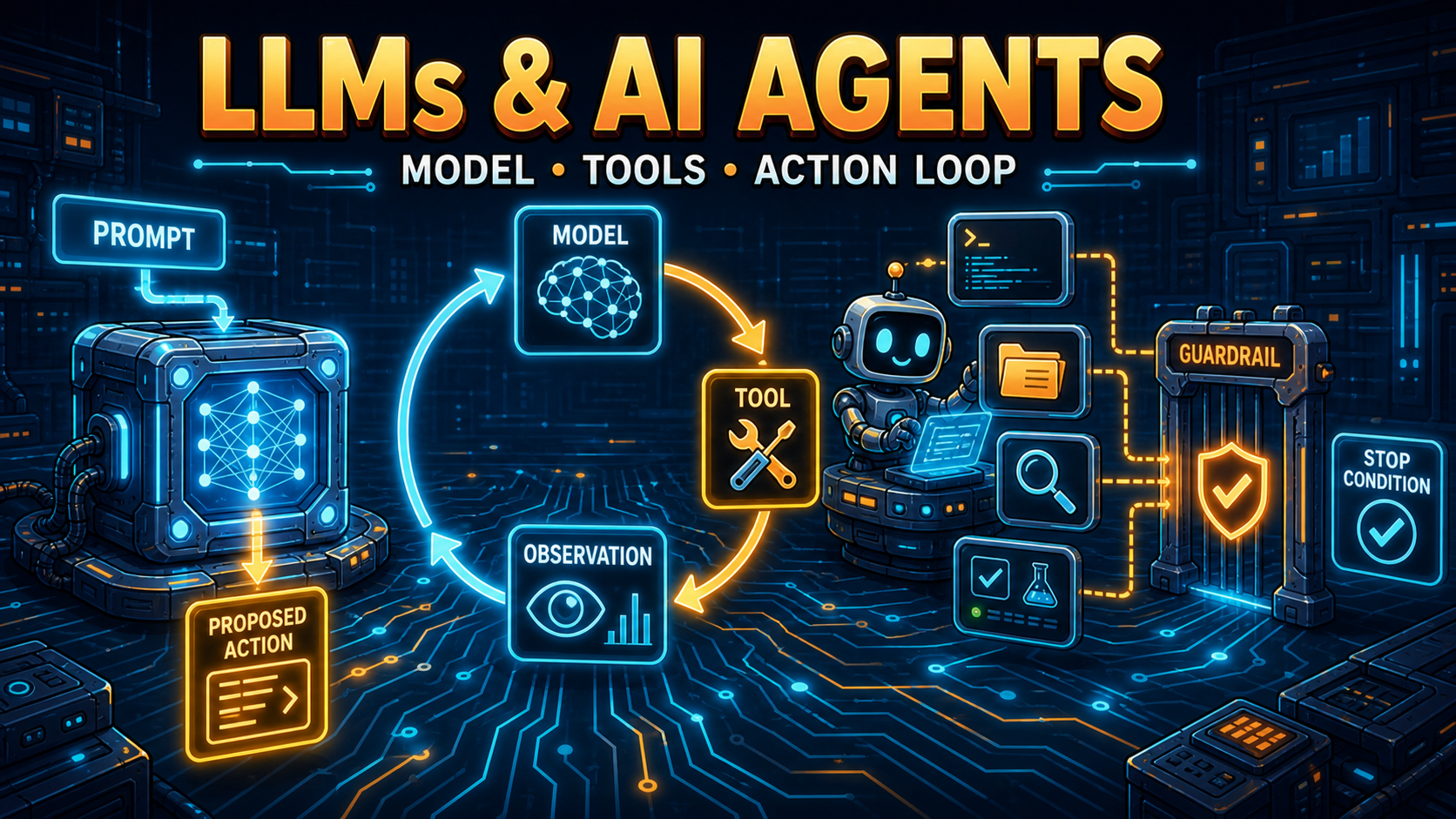
Two products can present the same chat box while running fundamentally different systems underneath. Simulator errors are routinely pasted into chat windows, so the distinction is already relevant to day-to-day verification work.
In the first product, you paste a UVM fatal into the window. A large language model (LLM) reads the text, explains the likely cause, and suggests a fix. The response ends, and you do the actual work.
In the second, you ask the same question and the system goes further. It opens the regression log, searches for related failures, inspects the referenced SystemVerilog source, checks recent diffs, runs a focused simulation, evaluates the result, edits a file in a controlled branch, and reruns the test. It continues until it reaches a completion condition or needs your input.
Both products might use the same underlying model. Their interfaces may look nearly identical. Architecturally, though, the first is a model-backed application, while the second can legitimately be called an agent because the model directs consequential choices inside a repeated execution loop.
So the LLMs vs. AI agents question is not about what the interface says. Not the “agent” label, the memory pane, or the search button. The useful question is:
Does the model only produce a candidate answer, or does it direct meaningful workflow decisions within a bounded observation loop?
An LLM is a model that interprets supplied context and generates output. An agent is a larger executing system in which a model directs parts of task execution. That distinction determines how much control, validation, and oversight the system needs before it goes anywhere near a regression farm or source repository.
What an LLM Is—and What One Model Call Does
At the application boundary, an LLM receives context and returns generated output. The application assembles that context: instructions, the user request, conversation history, retrieved documents, tool descriptions, and any prior results selected for inclusion.
The output might be prose, source code, structured JSON, a classification, a plan, or a proposed tool invocation. A strong model can infer likely causes and produce a sensible multistep investigation plan from what it was given. But the output remains a candidate, not an executing process.
A minimal model-backed log assistant looks like this:
response = model.generate(
    instructions="Explain the likely cause of this UVM error.",
    context=log_excerpt
)

print(response)
The model analyzed only the supplied excerpt. It did not open the complete log, locate source files, invoke the simulator, or confirm that its recommendation works. Those operations require surrounding application code and authorized interfaces.
Suppose the response says:
Run test
axi_write_timeoutwith seed 42 and inspect the waveform around the first timeout.
That is a recommendation. Running the test requires software that authenticates to the compute environment, validates the test and options, reserves resources, invokes the command, captures the result, locates artifacts, and reports what happened.
Even a structured tool request has no effect by itself:
{
  "tool": "run_test",
  "arguments": {
    "test": "axi_write_timeout",
    "seed": 42
  }
}
Application code must treat those arguments as untrusted input. It validates the test name and seed, applies resource limits, checks authorization, executes in an approved environment, and records the observation.
This is not pedantry. Proposed, executed, and passed are three different states.
A model may propose a valid command that the runtime rejects. The runtime may execute a command that fails. A command may return successfully even though the intended test did not complete or the expected artifact was never produced. A robust system must not collapse those states into a single success indication.
The verification analogy is straightforward: a scoreboard’s predicted value is not the DUT’s observed response. You would never mark a check as passed merely because the predictor produced something plausible.
A single model call can be approximated at its software boundary as:
candidate_response = LLM(instructions, current_context)
Do not read that as a claim that LLMs are pure or deterministic. Outputs can vary with sampling settings, model revisions, service behavior, and context construction. The notation describes the application boundary, not complete model semantics.
Memory usually belongs to the application
The term memory often blurs the model-system boundary. It may refer to several different mechanisms:
- Parameters learned during training
- The context window for the current invocation
- Conversation history resent by the application
- External records retrieved and inserted into later requests
A chat application can appear persistent even when the model stores no conversational state between calls. The surrounding application may simply replay previous messages or retrieve saved summaries.
Memory, retrieval, and long context can make an application more capable, but none proves that it is an agent. If fixed code decides when to retrieve information and what happens next, the control path remains predefined.
For engineering work, provenance matters more than the appearance of memory. A diagnosis should be tied to the source revision, regression identifier, simulator version, test configuration, seed, artifact versions, and relevant model and instruction versions. Otherwise, a polished explanation may be based on stale evidence.
What Makes an AI Agent a System Rather Than a Model
There is no enforced definition of agent. Product literature applies the term to almost any tool-enabled assistant, which makes arguments over labels less useful than examining control flow.
A practical operational definition is:
An AI agent is a system in which a model dynamically directs meaningful workflow decisions, observes the resulting environment, and decides whether to continue, finish, or hand control back.
OpenAI’s practical guide identifies model, tools, and instructions as foundational agent components. The model interprets the task and proposes decisions. Tools expose information or actions. Instructions define the goal, constraints, and operating policy.
Production systems need considerably more: orchestration, runtime state, typed tool adapters, authentication, authorization, validation, stopping rules, guardrails, tracing, resource limits, and human approval for consequential actions. An LLM is one component inside that system, not a synonym for it.
The bounded execution loop
The architectural tell is a loop: build context, obtain a decision, validate it, act, observe, and repeat.
state = initialize_task(user_request)

for step in range(MAX_STEPS):
    context = build_context(state)
    decision = model.generate(context)

    if decision.kind == "finish":
        return validate_final_answer(decision, state)

    if decision.kind == "request_approval":
        return needs_approval(
            proposed_action=decision.tool_call,
            state=state
        )

    tool_call = validate_and_authorize(decision.tool_call)
    observation = execute(tool_call)
    state = update_state(state, decision, observation)

return stop_with_limit_report(state)
This approval path intentionally stops the run and returns a needs_approval outcome. If the user approves, a new or resumed run records that approval before execution. The system should not imply that it both handed control back and continued automatically.
The runtime owns credentials, authorization, execution, state updates, and limits. The model selects among available next steps, but it does not grant itself permission to take them.
Tool output becomes an observation in state, allowing the next model invocation to revise the plan. Explicit completion, failure, approval, handoff, timeout, and step-limit outcomes keep the process bounded.
Real implementations also need sandboxing, credential isolation, retries, schema checks, redaction, concurrency control, audit logging, and recovery from partially failed operations. ReAct provides a useful conceptual pattern for interleaving reasoning and action, but it does not supply those production controls.
Operational observability should focus on action summaries, validated tool requests, results, approvals, state transitions, and completion evidence. It does not require exposing private chain-of-thought.
A verification-oriented analogy
An agent loop should look familiar to verification engineers. A controller chooses an operation, a policy layer checks it, a driver or adapter invokes an interface, and observations return through monitored state. Execution continues until completion, failure, timeout, or escalation.
| AI concept | Verification-oriented analogy |
|---|---|
| LLM call | Candidate decision from the current context |
| Instructions | Test intent, constraints, and operating policy |
| Tool schema | Transaction or interface contract |
| Tool execution | Driver or external command invocation |
| Observation | Monitor output, command result, or sampled state |
| Agent state | Task state, evidence, and execution history |
| Guardrail | Protocol checker, access rule, or assertion-like boundary |
| Exit condition | Completion, failure, timeout, or escalation |
| Trace | Transaction log and decision history |
The analogy is structural, not literal. LLM decisions are probabilistic, natural-language context can be ambiguous, and generated actions need deterministic validation before they mean anything. Still, interfaces, checked results, timeouts, and observable completion evidence are essential in both domains.
Tools, Workflows, and Agents
Tools alone do not create an agent.
Consider a chatbot with a Search documentation button. The user clicks it, application code performs a fixed search, and retrieved sections are appended to one model request. That is a useful tool-augmented LLM application. It is not necessarily agentic because the model did not decide whether to search, choose among meaningful actions, or iterate based on the result.
Anthropic describes an augmented LLM as one enhanced with capabilities such as retrieval, tools, and memory. It also distinguishes workflows, whose paths are defined by code, from agents, where the model dynamically directs its process and tool use.
A fixed retrieval pipeline, a hard-coded sequence of prompts, a classifier that routes tickets through predefined branches, or a model that formats arguments for a user-selected operation may all use tools without becoming agents.
The diagnostic question is:
When new information arrives, does predefined code choose the next step, or can the model choose among consequential next actions within runtime policy?
A router sits in the middle. A model might classify a failure as a compile error, timeout, or scoreboard mismatch and select one of three predefined diagnostic paths. That introduces limited model-directed branching, but the available routes remain tightly constrained. Depending on the design, it may be clearer to call this a workflow with model-based routing rather than a general agent.
Fixed workflows are often the better choice. If the sequence is known, draw the control-flow diagram and implement it in ordinary code. Collecting logs, summarizing them, opening a ticket, applying deterministic style fixes, and executing a compliance-sensitive release checklist do not need open-ended planning.
Agents become useful when the next action depends on observations that cannot be enumerated reliably in advance. Repository investigations, unfamiliar failure analysis, and migration work may require changing the order and number of steps as evidence arrives.
Hybrid architecture is usually the practical answer. Deterministic code handles authentication, artifact discovery, parsing, known checks, and acceptance. A bounded agentic stage chooses among narrow, authorized diagnostic actions. A fixed workflow then performs final validation or submission.
More agency is not a maturity level. It adds latency, cost, nondeterminism, validation burden, and attack surface. Agency buys feedback and environmental interaction; it does not buy correctness.
Three Practical Comparisons
Explaining a simulation log vs. investigating a failure
A model-backed assistant can explain a pasted UVM error, identify a likely phase-objection problem, and recommend checks. That is useful when the relevant evidence is already available and an engineer will review the response.
A bounded agent might open the complete log, find the earliest causal error, confirm the test seed and source revision, inspect nearby assertions, compare previous failures, and run one approved reproduction in a sandbox. It can then compare the new result with the original and return an evidence-backed summary.
It is agentic only if the model chooses among those diagnostic steps based on observations. A script that always performs the same eight operations is a workflow, even when one step calls an LLM.
Many routine failures can be narrowed substantially from logs, metadata, and read-only source inspection. That makes read-only triage a sensible first target. Source-write permissions are unnecessary if the system’s job is to collect evidence, identify likely causes, and stop for review.
Drafting an email vs. sending one
An LLM can draft an email from supplied context. An agentic system might retrieve project information, identify intended recipients, prepare the draft, check policy, request confirmation, and send it through an authenticated service.
Sending is more consequential than drafting. Approval should display the exact recipients, subject, body, and attachments—not merely ask whether the user wants to “continue.” A plausible message is not an authorized message.
Suggesting a verification plan vs. modifying a repository
A single model call can draft a verification plan from a specification excerpt. An agentic system could inspect the specification, existing tests, and coverage results before identifying gaps. It might prepare edits, run lint or compilation, and revise its patch based on results.
Generated coverage claims must be checked against the actual coverage database. Repository read access, branch modification, review submission, and merge authority should remain separate permissions.
The model’s claim that a patch works is not acceptance evidence. Compilation, lint, assertions, focused simulations, regression results, coverage checks, and human review determine whether the change is acceptable.
Why Agency Creates More Failure Modes
A wrong answer in a chat window remains text. A wrong action can change files, consume compute, send messages, or alter shared state.
Models can invent filenames, simulator options, APIs, and command syntax. They can choose the wrong tool, misread a log, pursue the same bad hypothesis repeatedly, or treat incomplete evidence as proof.
State creates additional hazards. Repository context may go stale, summaries may omit critical observations, and long contexts may bury the original objective. The agent’s internal account of what happened can diverge from the actual environment, much like a scoreboard drifting out of sync with the DUT.
Tool results also create a security boundary. Retrieved documents, issue descriptions, logs, source comments, and web pages may contain prompt injection intended to redirect the model. Tool output must therefore be treated as untrusted context, never as higher-priority policy. A log line can provide evidence; it cannot grant permissions or redefine operating instructions.
Operationally, agents may loop, terminate too early, or report partial completion as success. Every iteration adds model latency, tool latency, cost, and another opportunity for state inconsistency.
| Failure area | Example | Required control |
|---|---|---|
| Planning | Investigates the final fatal instead of the first causal error | Evidence requirements and bounded replanning |
| State | Assumes an edit succeeded when it failed | Read-back and state reconciliation |
| Tool input | Generates an unsafe shell command | Typed tools, schemas, and allowlists |
| Security | Follows instructions embedded in a retrieved issue | Policy isolation and untrusted-content handling |
| Completion | Reports a passing test without checking artifacts | Exit-code and artifact validation |
| Looping | Repeats the same reproduction attempt | Step, retry, time, and cost limits |
Reproducibility requires more than recording a simulator seed. Useful traces include the model version, system instructions, context references, validated tool arguments, tool outputs, permissions, approvals, repository commit, simulator version, test configuration, seed, and environment identifiers. Exact replay may still be impossible if the model service or infrastructure changes, but missing identifiers makes investigation much harder.
Keeping Humans in Control
Apply least privilege per capability: reading source, searching logs, executing allowlisted commands, writing a scratch workspace, modifying a branch, submitting a review, and merging or deploying. One broad credential should not grant all of them.
Explicit approval belongs before consequential actions such as changing tracked source, sending messages, launching expensive regressions, updating issue state, publishing artifacts, or modifying shared infrastructure. The approval should show the exact diff, command, recipients, resource estimate, or other material parameters.
Policy enforcement belongs outside the model. Validate tool arguments against schemas and domain rules. Restrict commands and paths. Diff writes before applying them. Run generated code through the same formatting, lint, compile, assertion, and test gates used for human-authored changes.
The runtime must distinguish command_executed from task_completed. Completion claims need evidence: exit status, expected artifacts, test-result records, file hashes, or coverage database queries.
Simulator behavior is project-specific. License failures, wrapper scripts, warning policies, artifact layouts, and exit-code conventions vary enough that a generic adapter will eventually report a pass for a run that never completed. Validate both status and expected project artifacts.
Every run should have limits on iterations, retries, wall-clock time, model spend, tool calls, and compute resources. It should end with an explicit outcome such as completed, failed, timed_out, needs_approval, or needs_human_input.
The agent must also be allowed to stop on uncertainty. “Insufficient evidence” is a valid engineering result. Forced completion encourages fabricated certainty.
Choosing the Simplest Architecture
Use a single LLM call when the required context is already available, the result is advisory text or code, no environmental action is required, and a person can review the output cheaply.
Use a fixed workflow when the sequence is known, deterministic routing works, or predictability and auditability dominate. Documentation lookup from a versioned specification is a good example: retrieve relevant sections, cite them, and answer. An open-ended agent adds little value.
Use an agent or bounded agentic stage when the next action genuinely depends on observations not known in advance, tool selection must adapt, and the benefit justifies the additional latency, cost, security controls, and validation burden.
A useful evaluation is to implement one low-risk task three ways: a single model call, a fixed workflow, and a bounded agent. For read-only regression triage, measure diagnostic quality, latency, cost, reproducibility, review effort, and failure behavior. The simplest architecture that meets the requirement is usually the right one.
Artificial intelligence is the broad field. An LLM generates output from supplied context. An augmented LLM adds retrieval, memory, or tools. A workflow connects components through predefined paths. An agent lets a model direct consequential choices within a bounded observation loop. The complete agentic system includes the model, tools, state, permissions, validation, guardrails, observability, stopping logic, and human oversight.
Do not evaluate an agent only by the intelligence of its model. Evaluate the complete control system: what it can observe, what it can change, how its actions are checked, and how it stops.
Sources
- OpenAI, A Practical Guide to Building Agents
- Anthropic, Building Effective Agents
- Google Research, ReAct: Synergizing Reasoning and Acting in Language Models
Pick one task in your verification workflow—triaging a nightly failure, drafting a test plan, summarizing a log—and classify it as a single model call, a fixed workflow, or an agent. Before adding agency, write down the tools the task needs, the permission each tool requires, the evidence that proves completion, and the condition that stops the loop.
It is the same review we run before giving a new testbench component access to a real interface. The questions have not changed; the component just happens to speak English.
Discussion
0 comments
No comments yet — start the conversation.